
Hear from Our Customers
Yellow jackets do not stay politely in one corner of your property. By late August, a mature colony near Loon Lake or backing up to the Drayton Plains Nature Center can hold 3,000 to 5,000 workers — all of them food-stressed, defensive, and not interested in sharing your backyard with you. That is the moment most people call. And it is exactly the moment when a wrong move makes things significantly worse.
Getting the nest treated correctly the first time means your deck is usable again. It means your kids can play outside without you scanning the yard first. It means the gap in your soffit that let them in gets identified and addressed — not just sprayed around. That matters especially in Drayton Plains, where a lot of the housing stock dates back to the 1940s and 1960s, and older wood siding and aging fascia boards give yellow jackets easy access to wall voids and attic spaces that newer builds simply do not have.
When the job is done right, you stop managing the problem and start ignoring it — because it is gone.
First Choice Pest Control was founded on May 31, 2005 — which makes 2025 our 20th year serving Southeast Michigan, including Drayton Plains and Waterford Township. Roger Chinault, our owner, has 26 years of hands-on pest management experience. He is not managing from a distance. He is in it, and that shows in how we operate.
One of the things that actually sets us apart is simple: you get the same technician every time. Not a rotating crew, not a seasonal hire filling in between semesters. The same trained professional who treated your Drayton Plains home last year already knows the entry points, the property layout, and the history. That kind of continuity is rare in this industry, and it is worth something when you are dealing with a recurring problem near the Clinton River corridor or along the Loon Lake shoreline.
We hold MDARD Pesticide Application Business License #250081, have completed Integrated Pest Management training, and have earned awards from both Angie’s List and HomeAdvisor. Seniors, veterans, and first responders receive discounts — no hoops, no gimmicks.
It starts with a conversation. When you call, our goal is to understand what you are dealing with — where you are seeing activity, whether they are entering the structure or nesting in the ground, and how long it has been going on. That information shapes everything that follows.
When our technician arrives, the first job is correct identification. Michigan has multiple yellow jacket species, and they do not all behave the same way. German Yellowjackets — the species most likely to be inside the walls of an older Drayton Plains home — require a completely different treatment approach than Eastern Yellowjackets nesting underground near the moist, wooded edges of the Nature Center on Hatchery Road. Applying the wrong product in the wrong location does not just fail — it drives the colony deeper and makes the problem harder and more expensive to fix. Identification comes first, always.
After treatment, you will know what was done, why it was done that way, and what to watch for in the days following. We back every yellow jacket service with a one-year guarantee. If activity returns within that window, so does the technician — at no additional charge. No contracts, no fine print, no runaround.
Ready to get started?
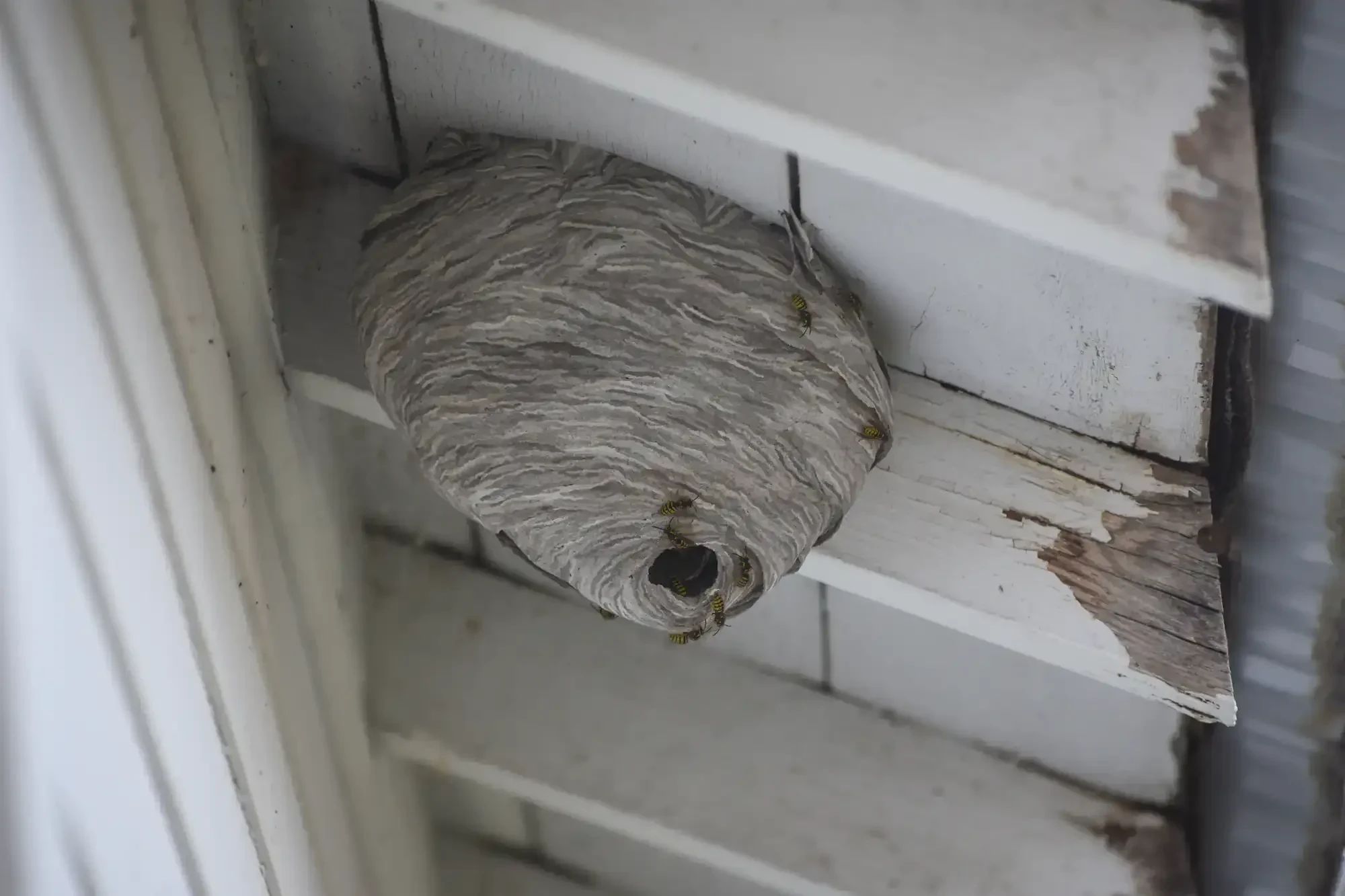
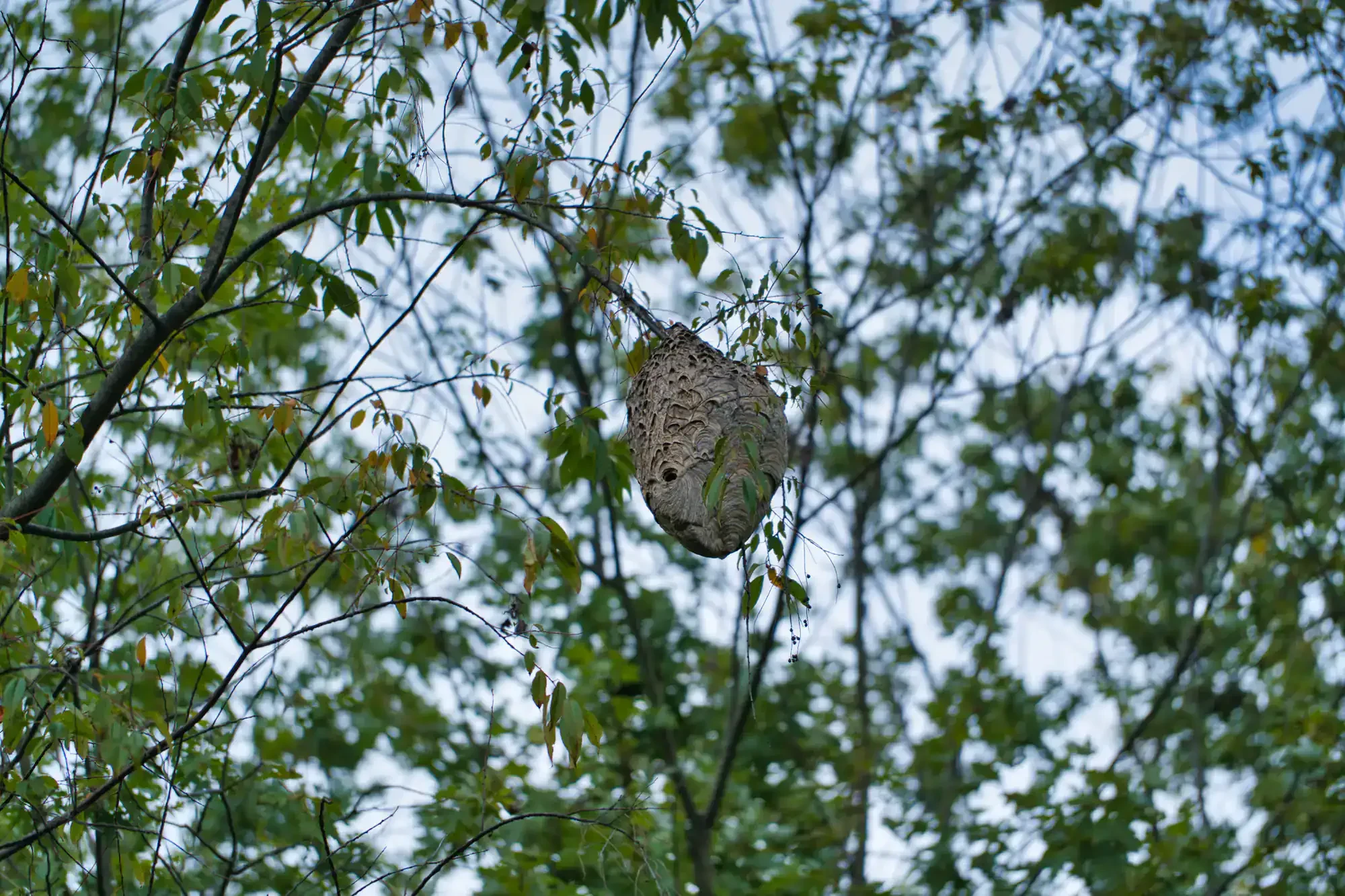
Yellow jacket extermination in Drayton Plains is not a one-size treatment. What you receive depends on what you are actually dealing with — and in this area, the range is wide. Ground nests near the Clinton River corridor and the wooded edges of Loon Lake are common, especially in the moist, soft soil that Eastern Yellowjackets prefer for underground colonies. Wall-void and attic infestations are equally common in the mid-century housing throughout Drayton Plains, where aging soffits, deteriorating fascia, and gaps in original wood siding give German Yellowjackets exactly the enclosed, protected entry they are looking for.
Every service begins with a thorough inspection — not just of where you saw activity, but of the full exterior to identify every potential entry point. Treatment is targeted and IPM-based, meaning the right product goes in the right place, with minimal unnecessary chemical exposure. That matters for families with kids and pets, and it matters for properties near the Nature Center’s trail system and the Loon Lake shoreline where environmental sensitivity is a real consideration.
We also offer price matching against reasonable competitor rates, so you are not paying a premium to get the most experienced local technician on the job. No binding contracts. One-year service guarantee. And if you are a senior, veteran, or first responder in the Waterford Township area, ask about your discount when you call.
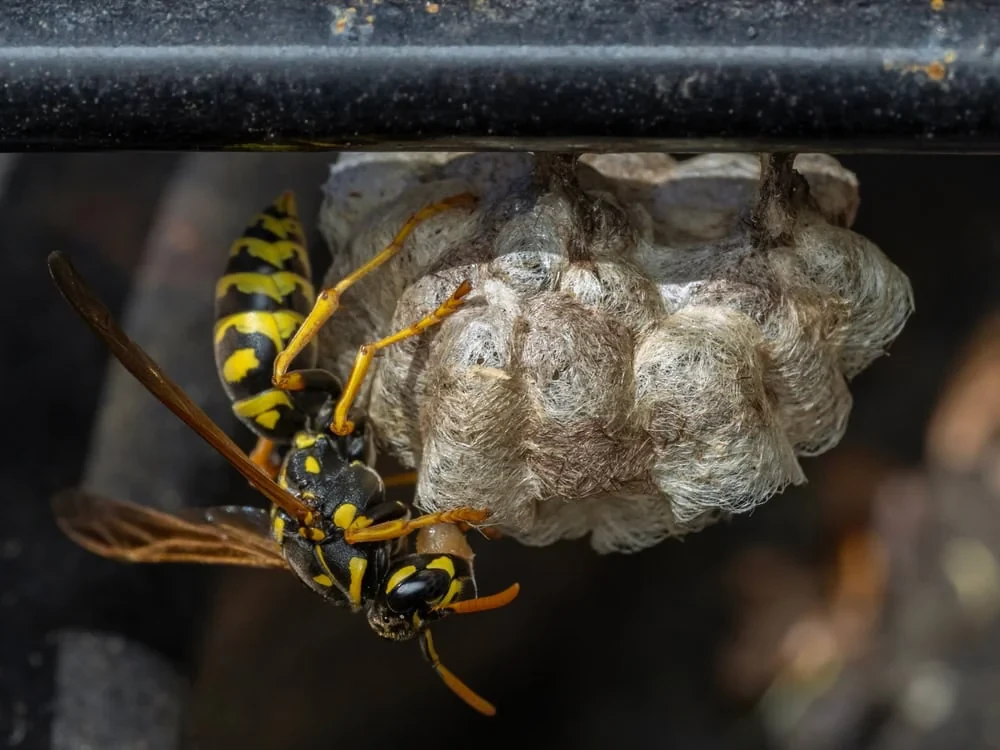
The clearest sign is consistent entry and exit activity at a single point on your exterior — usually a gap in the siding, a crack near the soffit, a space around a utility penetration, or a separation in the fascia board. You will often see workers flying in and out repeatedly throughout the day, not just hovering around. In some cases, you may hear a faint buzzing or chewing sound from inside the wall, particularly in the early morning or evening when the structure is quiet.
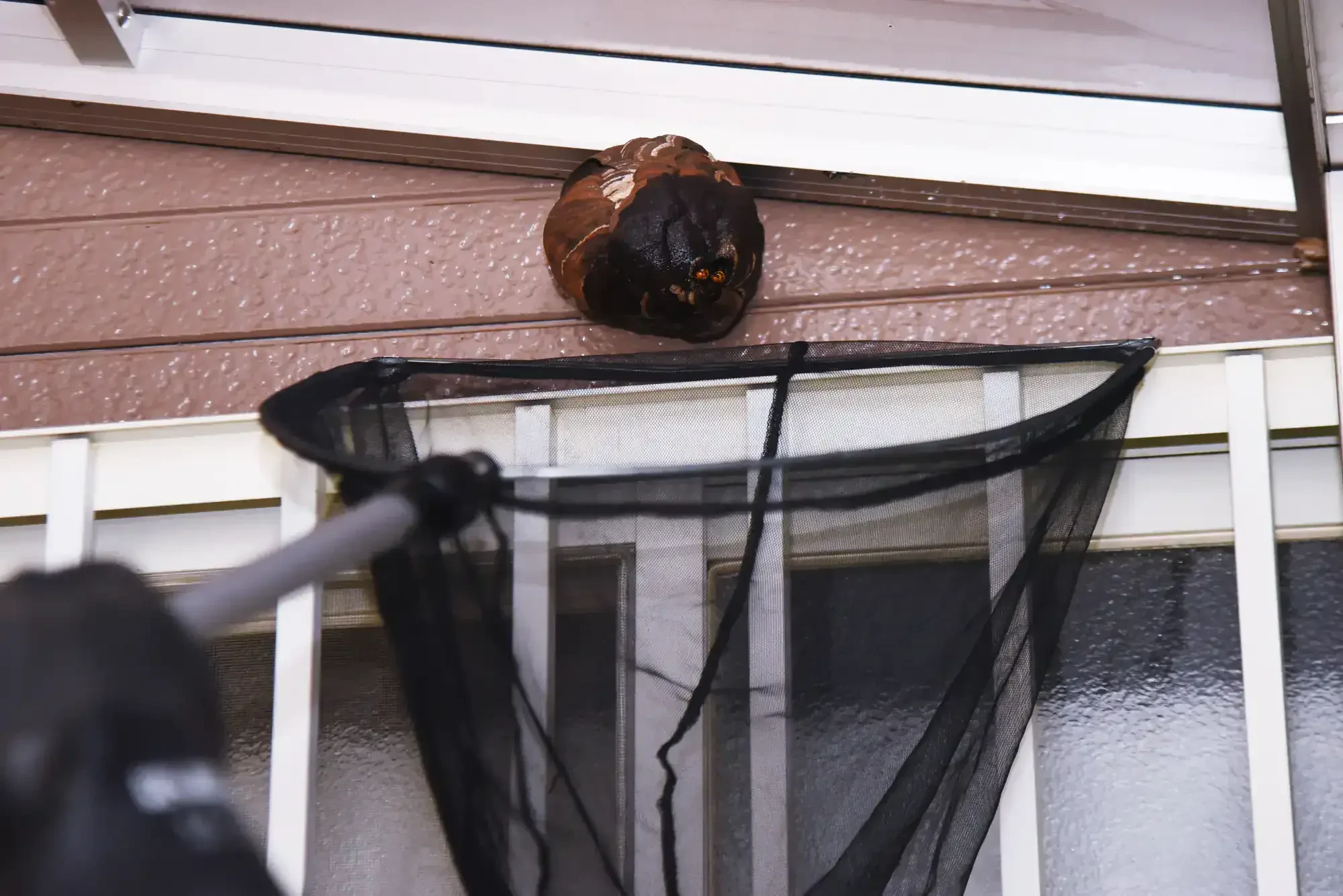
Drayton Plains homes built in the 1940s through 1960s are especially vulnerable to this because the original wood siding, aging soffit boards, and older chimney flashing develop small gaps over time that are invisible to a casual inspection but obvious to a queen looking for a protected cavity in late March. If you have noticed yellow jacket activity near your roofline or siding and cannot find a visible outdoor nest, there is a reasonable chance the colony is inside the structure. That situation requires professional treatment — not a can of spray from the hardware store, which will drive the colony deeper into the wall and make extraction significantly more difficult.
For a small, early-season nest that is fully exposed and easy to access, some homeowners attempt DIY treatment with limited success. But the scenarios that generate most calls to us are not small or early-season. By late August and into September — when Drayton Plains families are trying to use their decks and yards along the Loon Lake shoreline or near Shell Park — a mature colony can hold several thousand workers that are at peak aggression. Disturbing that nest without the right equipment, the right product, and a clear understanding of the species and nest location is genuinely dangerous.
The bigger risk with DIY on wall-void or attic nests is that partial treatment does not eliminate the colony — it displaces it. Workers that cannot exit through their original entry point will find another route, and that route is sometimes through a gap into your living space. That is a bad situation that is entirely avoidable. If there is any uncertainty about where the nest is, how large it is, or whether it is inside the structure, a professional inspection costs far less than the alternative.
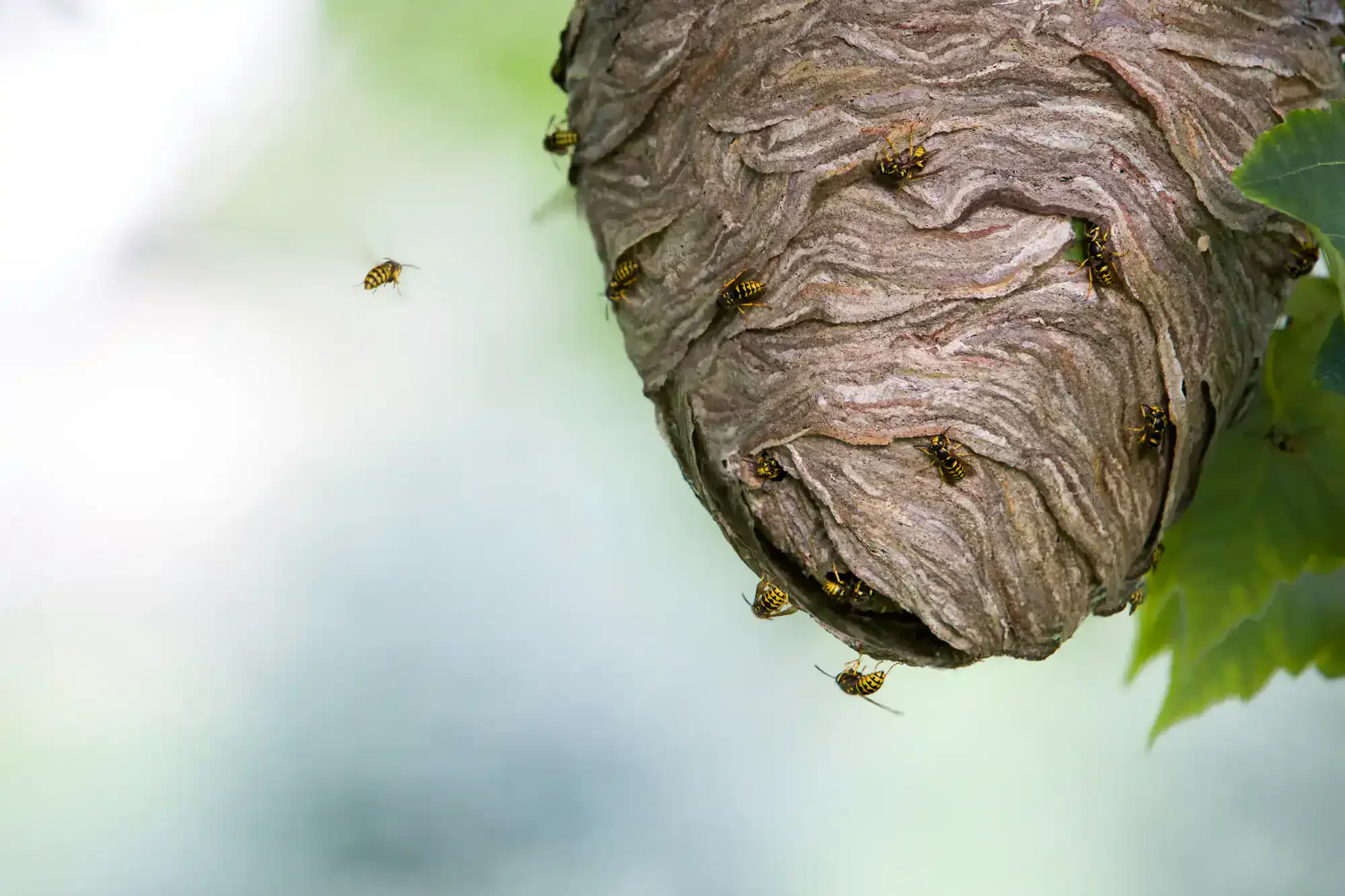
It comes down to colony size and food stress. In spring and early summer, a yellow jacket colony is small and focused on growth — workers are hunting insects to feed larvae, and they are generally not interested in you. By late August, the colony has reached its maximum size, the queen has stopped laying, and workers shift from hunting protein to seeking sugary food sources. That is why they are suddenly swarming your outdoor gatherings, your trash cans, and anything sweet near the deck.
In Drayton Plains specifically, this late-summer aggression is compounded by the proximity to the Drayton Plains Nature Center’s 138 acres of woods and prairie, and the wooded shoreline around Loon Lake. Those natural areas sustain large yellow jacket populations throughout the season. When colonies near the Nature Center’s edges mature in August, the pressure on adjacent residential properties increases noticeably. This is the window when most stings happen, and when most calls come in. It is also when the risk of anaphylaxis — a severe allergic reaction to venom — is highest, because exposure frequency goes up dramatically.
Nationally, yellow jacket extermination averages around $725, with wall-void and attic infestations on the higher end of the range — typically $500 to $1,300 depending on nest location, colony size, and how accessible the entry points are. Ground nests in open yards are generally on the lower end. Nests inside the walls of an older Drayton Plains home, where treatment requires locating hidden entry points and applying product into a confined structural cavity, tend to run higher because the work is more involved.
The more useful framing is what deferred treatment actually costs. A single emergency room visit for a severe allergic reaction runs $1,000 or more. Structural repair from an untreated wall-void infestation — replacing drywall, insulation, and damaged wood — can reach several thousand dollars. A second professional treatment because the first one failed adds another $500 to $1,300 on top of what you already paid. We offer price matching against reasonable competitor rates, so you are not forced to choose between experience and affordability. The one-year guarantee means your first investment is also your last one for this problem.
They can, and MSU Extension confirms that new queens will return to previously favorable nest sites if the entry point and conditions remain. Yellow jackets do not reuse the same physical nest — the old nest is abandoned each fall and new queens overwinter in protected locations, including under siding and inside the wood trim of older homes. But if the gap in your soffit or the crack near your chimney flashing is still there in March, a new queen looking for a nest site the following spring may find it just as attractive as the one before her did.
This is one of the reasons we do not just treat the colony and leave. The inspection process identifies every entry point on the exterior, not just the active one, so you understand where your home is vulnerable going forward. For Drayton Plains homeowners with mid-century housing, this matters more than it does for newer builds — older construction simply has more potential entry points that develop over time. Addressing them after treatment is the difference between a one-time fix and an annual recurring problem.
Yes. We offer discounts for seniors, veterans, and first responders. Waterford Township has a strong community of people who have served — in the military, in emergency response, and in public safety — and this is a straightforward acknowledgment of that. When you call to schedule service, just mention which discount applies to you and it will be factored into your quote.
Beyond the discount programs, we also match reasonable competitor rates. So if you have already received a quote from another licensed pest control company serving the Drayton Plains area, bring it to the conversation. The goal is to make sure cost is not the reason someone delays treating a yellow jacket infestation that is already a safety risk. There are no binding service contracts, and the one-year guarantee is included with every yellow jacket treatment — not offered as an add-on.
Useful Links