You’ve vacuumed. You’ve bombed the house. You’ve treated the dog. And two weeks later, you’re still getting bitten. If that sounds familiar, you’re not alone — and you’re not doing it wrong. The problem isn’t your effort. It’s that most flea treatments, including the ones sold in big-box stores and even some professional services, only address a fraction of the infestation. The rest keeps developing right under your feet. This page explains what’s actually happening inside your Genesee County home, why standard treatments miss it, and what a complete flea treatment approach looks like when it’s done right.
Why Flea Treatment Keeps Failing — Even When You’re Doing Everything Right
Here’s the part most people don’t know: adult fleas — the ones you can see jumping on your pet or across your floor — make up only about 5% of a flea infestation. The other 95% is eggs, larvae, and pupae living in your carpet fibers, under furniture, in floor cracks, and in your pet’s bedding. You can kill every adult flea in the room and still have a full infestation rebuilding itself within days.
Flea bombs and store-bought sprays are designed to knock down what’s visible. They’re contact killers — they work on what they touch. But they don’t penetrate deep into carpet pile, they don’t reach into furniture seams, and they don’t affect pupae at all. The pupal stage — the cocoon stage — is chemically resistant. Insecticides don’t kill it. So even a well-executed DIY treatment leaves the next generation completely intact.
That’s not a flaw in your technique. That’s just how the flea lifecycle works, and it’s why a single treatment, professional or otherwise, will never be enough on its own.
What the Flea Lifecycle Actually Means for Your Home
A single adult flea can lay up to 50 eggs per day. Those eggs fall off your pet as it moves through the house, which is why fleas end up in every room — not just where your dog sleeps. Under warm conditions, the lifecycle from egg to adult completes in about three weeks. That’s three weeks from egg to a new generation of biting adults, and the cycle repeats continuously if the environment isn’t treated properly.
The larvae that hatch from those eggs are photophobic — they actively move away from light and burrow deeper into carpet and furniture. That’s exactly why foggers miss them. The fog settles on surfaces. The larvae are already underneath.
Then there’s the pupal stage. Once a flea spins its cocoon, it can stay there for weeks, waiting for the right conditions — warmth, vibration, carbon dioxide — to trigger hatching. This is the stage that makes people think professional treatment didn’t work. You treat the house, things seem fine, and then ten days later you’re seeing fleas again. What you’re actually seeing is a new batch of adults that just hatched from pupae that survived the initial treatment. It’s not a treatment failure. It’s the lifecycle doing exactly what it’s designed to do.
This is why follow-up visits are non-negotiable. The first treatment handles the adults and the immature stages that are exposed. The second visit, timed to the lifecycle, catches the newly hatched adults before they can reproduce. Skipping that follow-up is one of the most common reasons infestations persist even after professional treatment.
Understanding this doesn’t just explain why your DIY attempts haven’t worked — it also tells you exactly what a complete flea treatment needs to address. It has to target all four life stages, in all the places they actually live, with products that have real residual staying power. That’s a different job than what a flea bomb is designed to do.
Why Genesee County Homes Face Flea Pressure Year-Round
Michigan has a real flea season — hot, humid summers with peak pressure in July and August — but that doesn’t mean the problem goes away when temperatures drop. If fleas have already established themselves inside your Genesee County home, your heated living space keeps the lifecycle running through fall and winter. A lot of homeowners in this area assume the cold will take care of it. It won’t, not once they’re inside.
The outdoor pressure in Genesee County is also higher than people expect. The area’s mix of suburban neighborhoods, wooded lots, and proximity to places like the Flint River corridor and Holloway Reservoir means wildlife traffic is constant. Deer, raccoons, and opossums move through yards regularly, and they’re all carrying fleas. Those fleas drop eggs in your grass, on your porch, near your foundation — and your pets pick them up every time they go outside.
Shiawassee County properties face similar pressure, especially on larger rural lots and acreages where wildlife is even more active. Properties near farmland or wooded edges often deal with flea and tick pressure simultaneously, which is part of why we include both in our mosquito treatment program at no extra charge. For homeowners with pets who spend time outdoors, that bundled coverage makes a real practical difference.
Older housing stock adds another layer. Many homes in Davison, Swartz Creek, Flint, and surrounding areas were built in the 1950s through 1980s — lots of carpet, older flooring with gaps, and more places for flea eggs and larvae to settle in and develop. Newer construction with hard floors is easier to treat. A 1960s ranch with wall-to-wall carpet in every room is a different situation entirely, and treatment has to account for that.
Flea season in Michigan also overlaps almost completely with tick season, running from roughly April through October. If you’re dealing with fleas and you have pets spending time outdoors near wooded areas, there’s a reasonable chance you’re dealing with tick exposure at the same time. Treating them as separate problems — or ignoring one while addressing the other — leaves a real gap.
What a Professional Flea Exterminator Does Differently
Professional flea extermination isn’t just a stronger version of what you can buy at the hardware store. The approach is fundamentally different because it has to address all four life stages, not just the adults you can see.
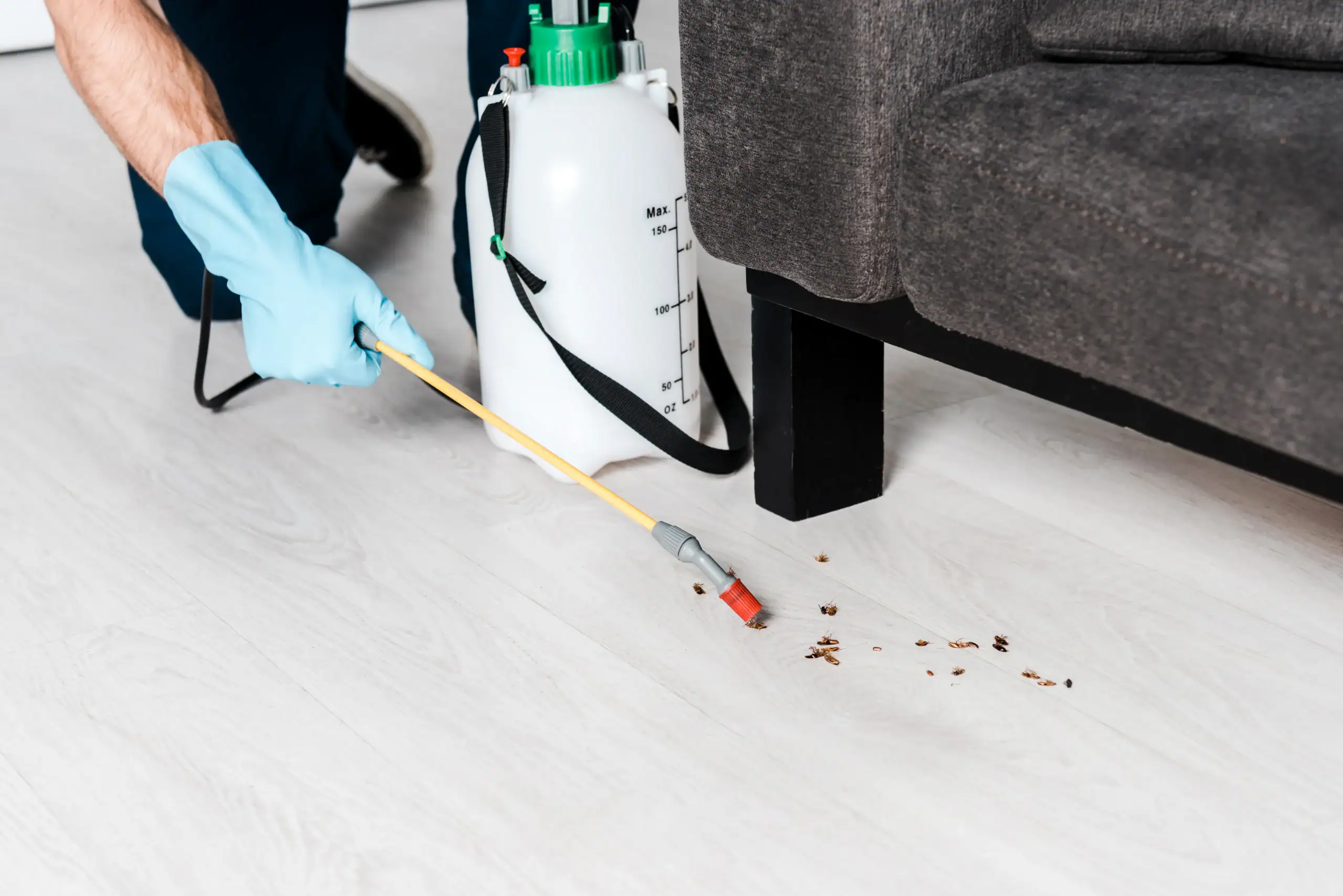
A proper treatment starts with an inspection — identifying where your pets sleep, rest, and travel, because that’s where the majority of eggs and larvae are concentrated. Then it moves to treating the environment with residual insecticides that keep working for weeks, combined with insect growth regulators (IGRs) that prevent immature fleas from developing into adults. That combination is what makes professional treatment more effective than anything available over the counter.
What to Expect Before, During, and After Professional Flea Treatment
Before treatment, you’ll be asked to do some prep work — vacuuming thoroughly, laundering pet bedding, and clearing floors so the technician can access baseboards and furniture edges. Vacuuming before treatment is actually important because it stimulates pupae to hatch, which exposes them to the treatment that follows. It’s one of those counterintuitive steps that makes a real difference.
During treatment, the focus is on source points — the areas where your pets spend the most time — as well as the full perimeter of each room, under furniture, and any exterior areas where flea activity has been observed. The products we use are professional-grade, meaning they have longer residual activity than what’s available to consumers. They’re also formulated for residential use, so the safety profile for pets and children is appropriate when applied correctly and allowed to dry.
After treatment, you should not vacuum for about ten to fourteen days. That residual treatment needs time to work, and vacuuming removes it from the carpet fibers before it can do its job. You’ll likely still see some flea activity in the days following treatment — that’s normal. Those are newly hatched adults emerging from pupae that survived. They’ll contact the residual treatment as they move through the environment.
The follow-up visit is where the lifecycle gets closed. Timed to roughly two to four weeks after the initial treatment, it catches the adults that hatched from surviving pupae and addresses any areas that need additional attention. For a true infestation, this step isn’t optional — it’s what separates a complete treatment from one that just delays the problem.
We’ve been treating homes across Genesee County and Shiawassee County since 2005. We know what works in Michigan homes, we know the seasonal patterns, and we know that flea treatment done right means following through — not just showing up once and hoping for the best.
Why the Same Technician Matters More Than You’d Think for Flea Control
Flea treatment isn’t a one-visit job. That’s just the reality. And when you’re dealing with a service that requires follow-up visits timed to the pest lifecycle, continuity matters in ways that aren’t obvious until you’ve experienced the alternative.
When a different technician shows up for your follow-up visit, they’re starting from scratch. They don’t know where your pets sleep. They don’t know what was treated last time, which areas were flagged, or what you reported seeing in the days after the first visit. They’re working from notes, if they have any at all. That’s not a knock on any individual technician — it’s just a structural problem with how a lot of pest control companies operate.
We assign the same technician to your property year after year. That person knows your home. They know your pest history, what’s been done, and what to watch for on a follow-up. For flea treatment specifically — where the follow-up visit is the visit that often determines whether the problem is actually resolved — that continuity makes a measurable difference in outcomes.
Roger has twenty-six years of hands-on pest control experience, and our technicians are career professionals, not seasonal workers or part-timers rotating through routes. That’s a deliberate choice on our part, because the quality of the person treating your home directly affects whether the treatment works.
We also don’t lock you into a contract. You’re not obligated to continue service after your problem is resolved. And if fleas come back between scheduled visits, we come back at no charge. That’s how we’ve operated since we opened in Swartz Creek in 2005. We’ve been here long enough to know that the only thing that keeps customers coming back is actually solving the problem.
For seniors, veterans, and first responders in the Genesee County area, we offer real discounts — not token amounts. And we match reasonable competitor rates, because we’d rather earn your business on the quality of our work than lose it over pricing.
Ready to Actually Get Rid of Fleas? Here’s What to Do Next
If you’ve made it this far, you probably already know that what you’ve tried hasn’t worked — and now you understand why. The flea lifecycle is the reason. Treating only the adults, skipping the follow-up, missing the source points — any one of those gaps is enough to keep an infestation going indefinitely.
A complete flea treatment targets all four life stages, covers the full environment, coordinates with your pet’s treatment, and includes a follow-up timed to the lifecycle. That’s the standard. Anything less is just buying yourself a few weeks of relief before the cycle starts over.
First Choice Pest Control has been treating homes across Genesee County and Shiawassee County since 2005. If you’re done guessing and ready to have someone who actually knows what they’re doing take a look, reach out to us and tell us what you’re dealing with. We’ll take it from there.