
Hear from Our Customers
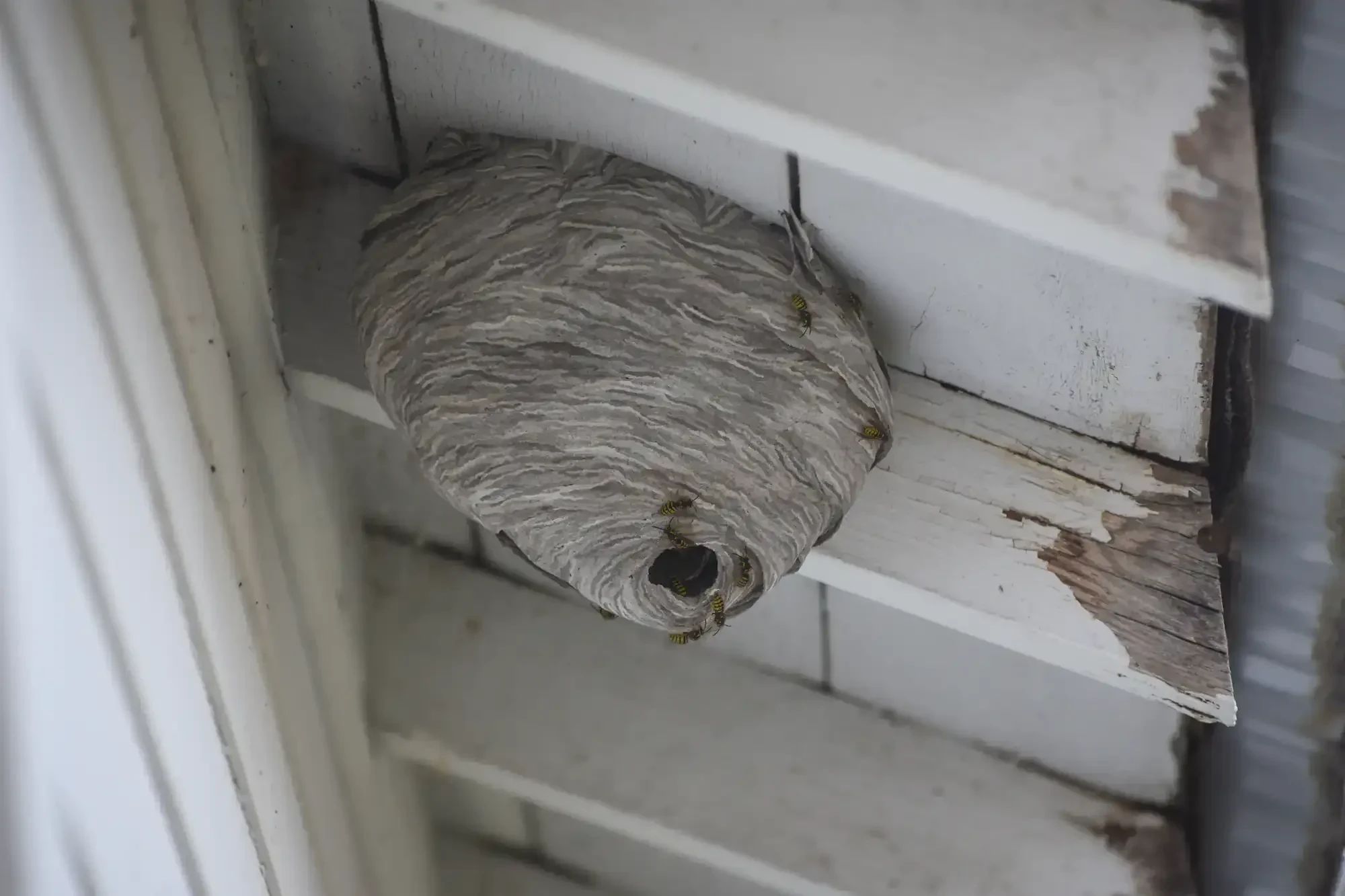
When yellow jackets set up in a wall void of an older Columbiaville home, or bury a ground nest in the wooded margin of a Marathon Township lot, the problem doesn’t fix itself. It grows. By late summer, a single colony can hold thousands of workers — all of them capable of stinging repeatedly, and all of them at peak aggression right when you’re most likely to be outside near the water.
Getting the nest handled correctly means you stop worrying about the back porch, the trail along the Southern Links, or the stretch of yard between the house and the tree line. It means your kids and your dog can be outside again. It means a cookout at Levi Cutting Park or an evening on the dock doesn’t come with a threat assessment attached to it.
For homeowners in Columbiaville’s historic village core — where aging siding, chimney gaps, and older wood framing are common — the structural risk is just as real as the stinging risk. German Yellowjackets chew through insulation and drywall to expand their nests. Treating it now costs a fraction of what ignoring it costs later. Yellow jacket pest control in Columbiaville, MI isn’t just about comfort. It’s about protecting your home and your family at the same time.
We founded First Choice Pest Control on May 31, 2005 — which means in 2025, we turn 20. That’s two decades of showing up for homeowners across Genesee, Lapeer, and surrounding counties, including families right here in Columbiaville. Roger Chinault, our founder, has 26 years of hands-on pest control experience and is personally invested in every job that goes out under the First Choice name.
We’re a family-owned operation, not a national franchise routing calls through a 1-800 number. We hold MDARD Pesticide Application Business License #250081 and are IPM training certified — meaning every treatment is built on correct identification first, not just a spray-and-hope approach. We’ve earned awards from Angie’s List and HomeAdvisor and carry a 4.7 out of 5 rating on Angi from verified customers.
There are no binding contracts. No rotating crew of seasonal workers who’ve never seen your property. The same technician comes back year after year — and that consistency matters when your home is in a wooded, waterfront community like Columbiaville where yellow jacket conditions change with the seasons.
It starts with a real inspection — not a glance at the exterior and a quote handed to you at the door. Michigan is home to two primary yellow jacket species with very different nesting behaviors, and treating the wrong one the wrong way makes things significantly worse. We identify the species first. If it’s a German Yellowjacket colony inside a wall void or attic — which is common in Columbiaville’s older homes along the historic village core — the treatment approach is different than if it’s an Eastern Yellowjacket ground nest buried at the edge of your tree line in Marathon Township.
Once the species and nest location are confirmed, we apply the right treatment directly and precisely. For wall-void and attic infestations, that means getting into the nest cavity without driving the colony deeper into your home’s structure — a mistake that’s easy to make with store-bought aerosols and hard to undo. For ground nests, timing and access matter. Entry points are identified and documented so you know exactly where the vulnerability is.
After treatment, you get a clear explanation of what was found, what was done, and what to watch for going into next season. Lapeer County’s wooded, waterfront environment means new queens emerge each spring looking for the same entry points last year’s colony used. Sealing those gaps after treatment is part of the conversation — not an upsell, just good information.
Ready to get started?
We handle yellow jacket nest removal in Columbiaville, MI for both residential and commercial properties — from single-family homes on standard village lots to larger acreage properties in Marathon Township where wooded surroundings and undisturbed ground create prime nesting conditions. Whether the nest is in a wall void, an attic, a crawlspace, or underground, our service is built around what’s actually in front of the technician — not a one-size-fits-all package.
Every job is covered under a 1-year service guarantee. If yellow jacket activity returns to your Columbiaville property within the guarantee period, we come back and re-treat at no additional charge. That matters in a community where older homes with aging exteriors give next year’s queens an easy path back in if entry points aren’t addressed. All work is performed under MDARD Pesticide Application Business License #250081, satisfying Michigan’s state requirements for professional pesticide application.
We also offer price matching for reasonable competitor rates — so if you’ve already gotten a quote from another licensed, insured provider serving the 48421 area, bring it. Seniors, veterans, and first responders receive discounts, because this community has earned them. No binding contracts, no pressure, and no part-time technicians who disappear after Labor Day.
The most common sign is consistent yellow jacket activity near a single point on your home’s exterior — a gap in the siding, a crack in the soffit, or a space around a window or door frame — especially when there’s no visible nest nearby. If yellow jackets are going in and out of the same spot repeatedly, there’s almost certainly a colony inside. You might also hear a faint buzzing or chewing sound from inside a wall cavity, or notice yellow jackets appearing inside the house through light fixtures, electrical outlets, or ceiling gaps.
In Columbiaville’s older homes, this is more common than most people expect. Aging wood siding, deteriorating soffit boards, and gaps in chimney mortar give German Yellowjackets exactly the kind of enclosed, protected cavity they look for. The worst thing you can do at that point is spray a store-bought aerosol into the entry point — it agitates the colony without eliminating it and can drive thousands of workers deeper into your home’s structure. If you’re seeing consistent activity at a single exterior point, call us before you try anything on your own.
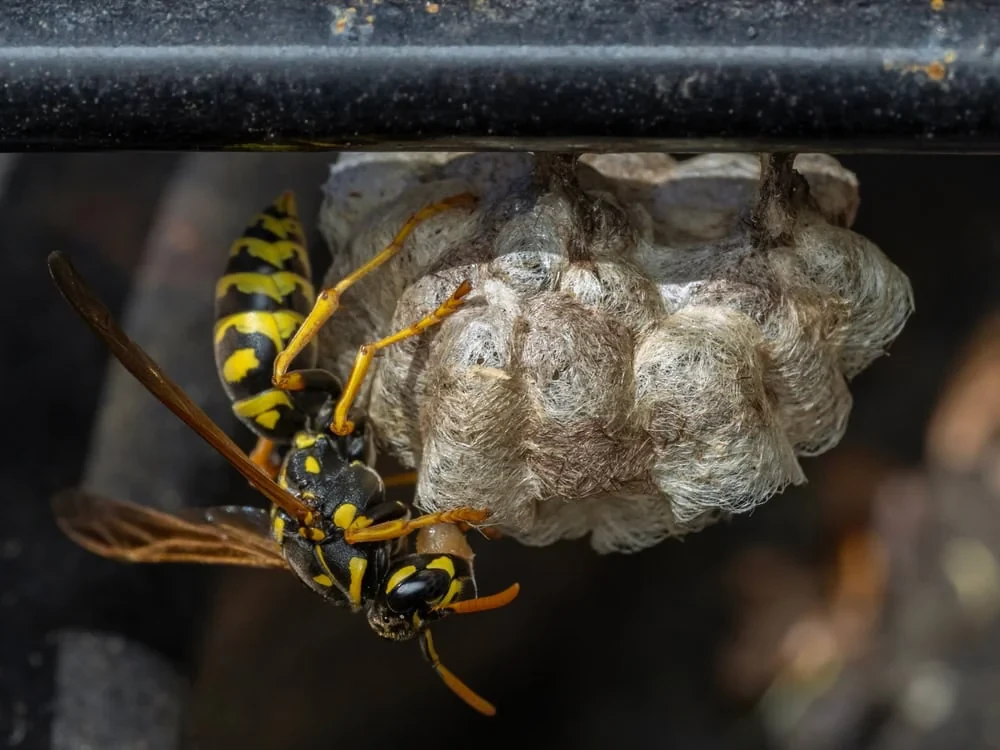
Yellow jackets are a type of wasp — but the term “wasp” covers a wide range of species, including paper wasps and hornets, that behave very differently and require different treatment approaches. Yellow jackets are smaller, more aggressive, and far more likely to sting repeatedly without much provocation. They’re also the species most likely to nest inside structures or underground, which is what makes them particularly problematic for homeowners.
Paper wasps, by contrast, build the open, umbrella-shaped nests you’ll often see under eaves or on porch ceilings. Those are generally easier to treat and less aggressive. Yellow jackets — especially German Yellowjackets inside wall voids — are a different situation entirely. The colony is hidden, the workers are defensive, and the access point is often small and deceptive. Correct identification before treatment isn’t optional. It determines what product we use, how we apply it, and whether the treatment actually works. Our IPM-certified approach starts with identification every time — not assumptions.
August and September are the peak months, and they’re also the worst possible timing for a community built around outdoor summer living. By late summer, a yellow jacket colony that started with a single queen in April can hold anywhere from 1,000 to 5,000 workers. At the same time, the colony’s food needs shift — they become less focused on hunting insects and more aggressive about finding sugary foods and proteins, which is exactly what’s on every dock, campfire, and picnic table in the Holloway Reservoir area.
That collision — maximum colony size, maximum food aggression, maximum human outdoor activity — is what makes late summer yellow jacket calls so urgent. If you’re noticing heavy activity around your yard or home in July, don’t wait until August to call. Treating a colony while it’s still building is faster, safer, and less expensive than treating one at full strength. We serve Columbiaville and can typically get to you quickly — response time matters when the problem is at your back door.
For a small, exposed nest early in the season — maybe a paper wasp nest under an eave — a careful DIY treatment is sometimes workable. Yellow jackets are a different situation. Ground nests are invisible until you’re standing on top of them, and wall-void nests are completely inaccessible without knowing exactly where the colony is and how to treat it without driving it deeper. Store-bought aerosol sprays can agitate a wall-void colony severely, causing workers to chew through drywall and emerge inside the living space. That’s a significantly worse outcome than the original problem.
The other issue is protective equipment and product access. Professional-grade treatments used for enclosed yellow jacket nests aren’t available over the counter, and the application method matters as much as the product itself. If the nest is small, early-season, and fully exposed, you might manage it. If it’s August, the colony is established, and there’s any indication the nest is inside a wall or underground near a high-traffic area of your yard — especially with kids or pets around — professional yellow jacket nest removal in Columbiaville, MI is the right call.
The colony itself won’t survive the winter — workers die off in the fall, and the nest is abandoned. But the entry point they used is still there. Yellow jacket queens overwinter in protected sites and emerge each spring actively searching for a suitable nesting location. If your home has a gap in the soffit, a crack in the siding, or an open chimney mortar joint — the same vulnerabilities that made it attractive last year — a new queen can find it and start a new colony in the same wall cavity the following spring.
This is one of the most common reasons homeowners call us back the year after a treatment. The original colony was eliminated, but the access point was never sealed. In Columbiaville’s older housing stock, those gaps are common and sometimes hard to spot without knowing what to look for. After treatment, we walk you through where the entry points are and what needs to be sealed to reduce the risk of recurrence. Our 1-year service guarantee also means that if activity returns within the guarantee period, you’re covered — no additional charge.
Yes — we offer discounts for seniors, veterans, and first responders. Columbiaville is the kind of community where those groups are woven into the fabric of everyday life, and the discount reflects that. It’s applied straightforwardly when you call and mention it — no hoops, no fine print.
We also price-match reasonable competitor rates. If you’ve already received a quote from another licensed, insured pest control company serving the 48421 area, share it when you call. The goal is to make sure cost isn’t the reason you end up with a less experienced provider handling a job that directly affects your family’s safety and your home’s structure. You get the 20-year track record, the licensed and IPM-certified technicians, the same-technician relationship, and the 1-year service guarantee — at a price that holds up against anyone else in the market. No binding contracts, no pressure, and no surprises when the invoice arrives.
Useful Links